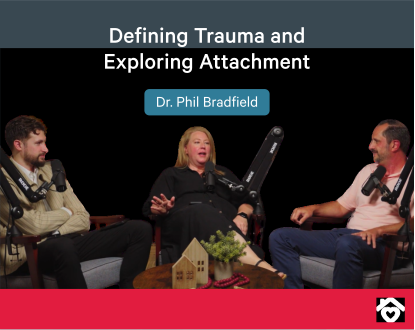
Why the Church Needs a Trauma-Informed Approach
We are living in a culture filled with crisis. But imagine if the world were knocking on the doors of the church because they knew we had solutions.
When I look at our culture, I see epidemic-level problems in mental health, opioid addiction, a broken child welfare system, sex trafficking, and overpopulated prisons. Foster children who age out of care are far more likely to struggle with mental health issues, addiction, sex trafficking, or incarceration; all of which perpetuate generational cycles of brokenness.
The Impact of Childhood Trauma
- 71% of girls who age out of foster care become pregnant by age 20; 50% of those babies then enter foster care. [1]
- The statistics on childhood trauma leading to adult addiction are staggering. Watch this video to learn more. [6]
- Mental health issues have risen significantly over the last decade, especially during and since 2020. Approximately 85% of children in foster care experience mental health challenges, and 90% of people in residential treatment report childhood trauma. [2]
- The United States holds 25% of the world’s prison population. By age 17, over 50% of foster youth encounter the legal system. Additionally, 25% of youth who age out of foster care become incarcerated, and 85% of incarcerated youth come from fatherless homes. The U.S. prison system is, in many ways, a for-profit institution built on the backs of one of the most fatherless generations in American history. [3] [4] [5]
- Of those rescued from sex trafficking, 70% had previously been in foster care. [8]
My point in sharing this information is to highlight the unfortunate reality that foster care can become a feeder system into even darker and more destructive systems. What all these outcomes share in common is childhood trauma. More specifically, attachment trauma.
Understanding Attachment Trauma
Attachment trauma occurs when a primary caregiver does not or cannot provide the consistent care that infants and children need. This form of developmental trauma can result in lasting neurological impact, and as these children grow into adults, they often struggle to cope in healthy ways.
This is where becoming trauma-informed can be incredibly helpful for the church and for the communities it serves. At its core, being trauma-informed means shifting the question from “What is wrong with you?” to “What happened to you?” when we encounter difficult or undesirable behaviors.
What is Trauma-Informed Care
Currently, there is no universally agreed-upon definition of trauma-informed care across all fields. However, in 2010, a widely recognized definition emerged based on the collective work of several experts:
“Trauma-informed care is a strengths-based framework grounded in an understanding of and responsiveness to the impact of trauma. It emphasizes physical, psychological, and emotional safety for both providers and survivors, and creates opportunities for survivors to rebuild a sense of control and empowerment.” [7]
In essence, trauma-informed care is about recognizing how widespread trauma is, learning to respond with sensitivity, and cultivating a culture that reflects those values within a church community.
At WinShape Homes, we define trauma-informed care as: “Individualized healing care for children and families that establishes felt safety, restores secure attachment, and is clinically informed.”
Our goal is to be highly practical, especially in helping children experience felt safety and develop secure attachment, two deeply connected realities.
Attachment and Felt Safety
Attachment is the foundation of how relationships are formed. Developmental psychology teaches that all human beings are born with a need for close emotional connection with at least one caregiver. The quality of attachment formed in infancy (0–6 months) significantly shapes how we connect in future relationships.
The encouraging news is that healing from unhealthy attachment is possible.
Felt safety occurs when adults intentionally shape both the environment and their own responses so that children experience a deep and consistent sense of safety. The goal of felt safety is connection, or secure attachment. It reflects God’s approach of using kindness to lead people to repentance (Romans 2:4), rather than punishment.
Many children in foster care have never experienced this kind of goodness, where their behaviors are understood within the context of their story, not simply corrected in isolation. Yet this is at the heart of the gospel. This is what God has done for each of us. So why would we not extend the same grace to the most vulnerable in our culture?
Caring for the Most Vulnerable Strengthens the Whole Church
Have you ever heard of the curb-cut effect? When sidewalks are designed with curb cuts for individuals in wheelchairs, those same adaptations benefit many others: parents pushing strollers, delivery workers with carts, or runners moving through the city. Designing for the most vulnerable ultimately serves everyone.
The same is true of trauma-informed care. When we care well for the most vulnerable, we strengthen the entire community. A church that becomes skilled in trauma-informed care is uniquely positioned to bring meaningful solutions to many of the issues connected to foster care: mental health struggles, addiction, trafficking, and incarceration.
Jesus consistently approached people with grace, looking beyond their shortcomings to first address their woundedness. He offered kindness that led to clarity, transformation, and repentance.
Consider John 4, the story of the woman at the well. Jesus revealed intimate knowledge of her life. Five marriages and a current relationship outside of marriage, yet he did not begin with condemnation. Instead, he acknowledged her story. In doing so, he communicated, “I see you. I understand your situation.”
This woman came to the well at a time when she expected to be alone, likely to avoid shame and social judgment. She was vulnerable. Yet after encountering Jesus, she became a messenger to her entire community, and many believed because of her testimony.
Care for the most vulnerable becomes care for the whole community.
A Call for the Church to Act
I return to the original question: What if the world was knocking on the doors of the church because they knew we had solutions?
Not just answers, but tangible, lived-out solutions, modeled after Jesus himself.
The church has done well to declare the gospel and defend the gospel. But we have an opportunity to more fully demonstrate the gospel.
Works Cited
- (2026, June 1). What percentage of girls in foster care are pregnant by 21? https://www.fosterva.org/blog/what-percentage-of-girls-in-foster-care-by-21
- (2026, January 22). Facts about mental health in foster care. https://www.fosterva.org/blog/facts-about-mental-health-in-foster-care
- Walmsley, R. (2013). World prison population list (10th ed.). International Centre for Prison Studies. https://www.prisonstudies.org/sites/default/files/publications/wppl_10.pdf
- Perez, J. (2023, February 24). The foster care-to-prison pipeline: A road to incarceration. https://www.crimlawpractitioner.org/post/the-foster-care-to-prison-pipeline-a-road-to-incarceration
- Rochester Area Fatherhood Network. (n.d.).
- KPJR FILMS LLC. (n.d.). ACES Primer [Video]. https://vimeo.com/139998006
- Trauma Informed Oregon. (n.d.). What is trauma informed care? [PDF]. https://traumainformedoregon.org/wp-content/uploads/2016/01/What-is-Trauma-Informed-Care.pdf
- Hassanein, N. (2023, November 22). Foster care kids are often sex trafficked. Many states fail to figure it out. https://stateline.org/2023/11/22/foster-care-kids-are-often-sex-trafficked-many-states-fail-to-figure-it-out/

Discover How You Can Make a Difference
Caring for children impacted by trauma starts with simple, practical steps. Discover what foster care could look like for you as an individual or family.